
A blank wall in a room might make it feel unfinished. Filling it with the initial beautiful painting is not always the correct solution.
A good piece of artwork can alter your room decor. It can be used for introducing color, creating a focal piece, to personalize, to connect different sections of your interior, or for simply providing you with something to look at daily.
Choosing artwork for your home, however, is about more than finding something you like. The look of a piece will be influenced by scale, placement, color, style, lighting, and the character of the room.
If you are decorating a new addition to your home, these practical guidelines will assist you in selecting artwork that feels like it belongs there without looking too coordinated.
Start With the Space, Not the Artwork
It can be tempting to fall in love with a painting first and figure out where it will go later while selecting room decor.
Instead, begin by looking at the space you want to decorate.
Where will the artwork hang? Above a sofa? Over a bed? Beside a dining table? In an entryway? On an empty wall?
The location immediately gives you useful information about the kind of artwork that might work.
If you have a spacious living room, there’s room for a big piece; if it’s a narrow hallway, you should try a vertical mosaic or several smaller ones. Quieter imagery would be found in a bedroom, and more energetic imagery would fit into a home office.
Consider the current style, decor, color scheme, shapes, floor, and other items in the room when you make your decision. Guidance on interior design always focuses on taking into account the existing space and its dimensions, rather than thinking of the artwork itself as a piece removed from a context.
The purpose isn’t to use it to hide the artwork within the room.
This is to ensure the work of art is purposeful with the room.
Get the Scale Right
A very frequent room decor error is to pick artwork which is too small for the space.
The color and details of an amazing painting will be lost when placed over a huge sofa or a vast empty wall. On the other hand, a large piece of art is likely to overwhelm a small room.
An excellent rule-of-thumb is the two-thirds rule, which states that the artwork should be approximately 2/3 of the width of the furniture it is over. For instance, a sofa measuring 180 cm could be great for a piece of art or a grouped arrangement around 120 cm wide.
It’s a guideline and not a formula. Too large isn’t necessarily a bad design rule; a series of small works can have the same visual weight as a large work.
Measure the wall and the furniture below the wall before purchasing.
Best of all, use paper or cardboard cut to the artwork’s dimensions and temporarily attach it to the wall. This will give you a great idea of scale compared to a computer screen.
Think About Height and Placement
The mistake of hanging artwork too high is easily corrected by the right piece of art while choosing room decor.
The basic room decor rule is that the center of the piece of art should be around the average eye level (57-60 inches or 145-152 cm above the floor in most places). If, however, the artwork is displayed as part of a furniture piece, then perhaps measurement from eye-level becomes less important than the relationship between these two pieces.
For a sofa, console, or other similar piece, be sure there is enough space between the bottom of the furniture and the bottom of the artwork, so that it seems like a unified piece rather than disjointed.
One practical approach to consider is about 6–8” (15–20 cm) distance between the furniture and the lowest level of the frame.
The idea is to conceptualize the art and furniture as a single composition.
It is not that you are decorating the wall and furniture individually.
You are building up and establishing a visual ‘connection’ between them.
Choose Colours That Work With the Room
You don’t need to match your sofa, your curtains, your cushions and your rug with your pictures when selecting room decor
In many cases if you try to match it one to one, it can be very reminiscent of a museum hall with the same vibe as a showroom.
Rather, search for connotations.
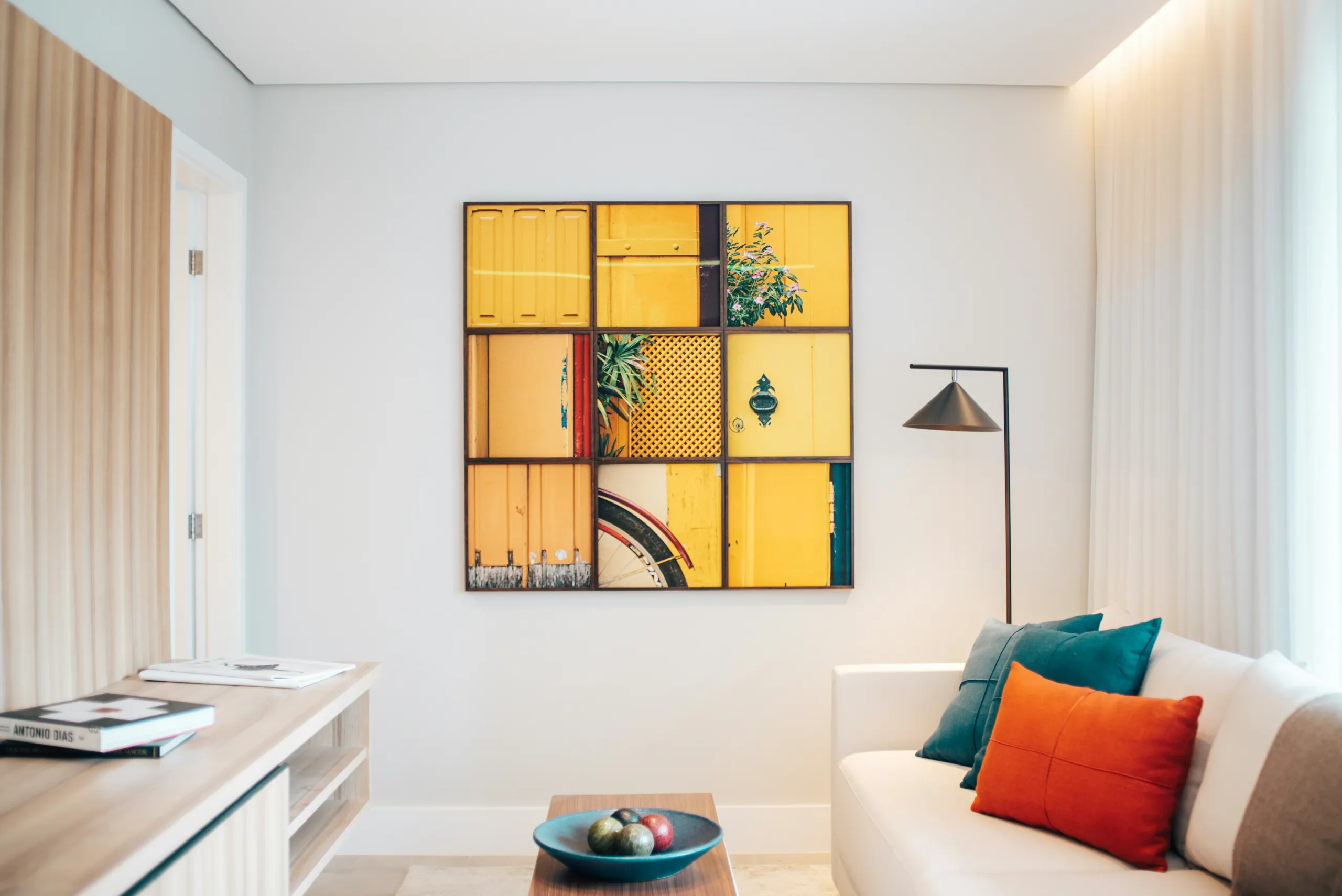
The piece of art may replicate a color in the space. Warm, terracotta hues can match a wood floor or earthy-coloured couch. A blue piece of art may share its color with one in the rug or a vase but not the same color.
Artwork can also be used to create contrast.
A vibrant painting can be found in a neutral room. The use of colors inside the room can work well with a tranquil b&w work.
It is essential to take into account the overall visual balance of the room. Designers tend to say that it would be better to have something that clearly captivates your eye in the beginning animation to open the scene instead of having lots of strong effects fighting for the spotlight.
See colour as a conversation, not a matching game.
Let the Room’s Mood Guide You
Different rooms naturally invite different moods.
That does not mean there are strict rules about what artwork belongs in each room. Your home should reflect your personality, not an interior-design formula.
But the function of a room decor can help narrow your choices.
Living Room
This is often the easiest place for a statement artwork because it is a social space and usually has enough wall area to accommodate something visually significant.
Abstract art, landscapes, portraits, photography, and large-scale contemporary works can all work well here.
Bedroom
If you want the bedroom to feel restful, consider artwork with softer colours, quieter compositions, landscapes, abstract forms, or imagery that has personal significance.
But if bold art makes you happy, there is no reason you cannot use it.
Dining Room
The dining area can handle artwork that encourages conversation. Still lifes, food-related imagery, expressive abstracts, or culturally significant works can give the space a distinct identity.
Home Office
Your workspace is an opportunity to introduce something energizing or intellectually stimulating. Consider artwork that reflects your interests, creative ambitions, or personal aesthetic in your office room decor.
Entryway
The entryway creates the first visual impression of your home. A striking artwork can establish the atmosphere before someone even enters the main living space.
Decide Between One Statement Piece and a Gallery Wall
It’s not all of the walls have to have one big painting on them.
Sometimes a bunch of photos conveys a more compelling narrative.
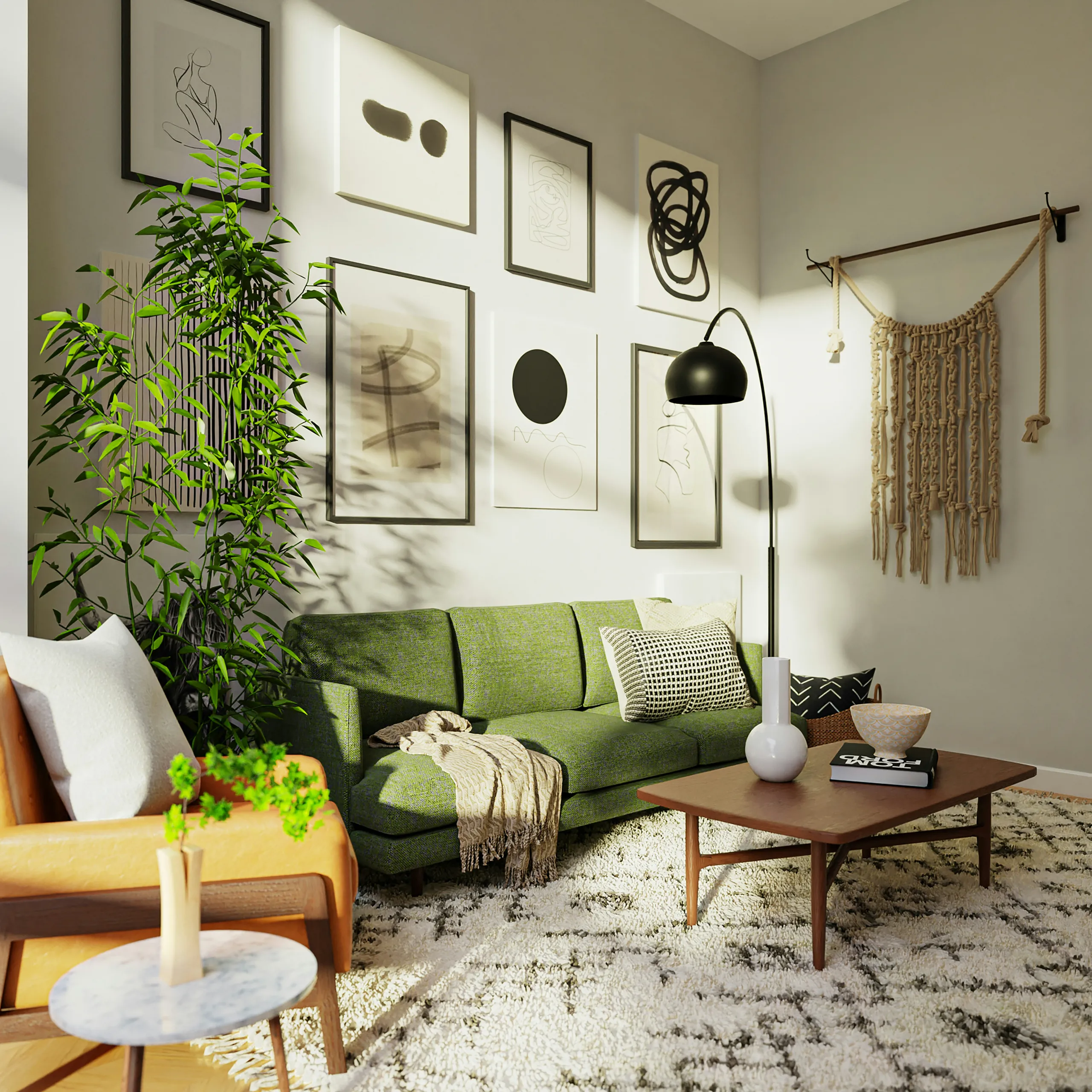
A gallery wall includes the ability to line up various pieces or images of art and/or photography, prints or objects, etc. It can be effective if you have multiple smaller items that are connecting on a color scheme, or idea, or design or personal relationship.
It’s about considering the whole grouping as a single artwork.
Spread the pieces on the floor. Play with the setup before making perforations into the wall. Maintain some sense of continuity in spacing to create a sense of intentionality.
If you’re hanging items in a gallery over furniture, think of the total width of all of the pieces, not the individual widths. The proportion of the arrangement to the furniture below should generally be proportional.
Note: pieces do not need to match while selecting room decor.
Contemporary painting can be used as a counterpoint to a vintage photography. A little drawing can make a soft accompaniment to the larger abstract art.
Uniformity is not a requirement for cohesion.
Consider the Artwork’s Style
Your house room decor and interior style can have a great deal of help to you but you shouldn’t stick to it completely.
A painting is a good way to make a minimalist interior more interesting. Traditional houses also make a place to show contemporary photography. A contemporary apartment can turn into an assertion by means of an antique or important function.
Rather than the question of “Does this artwork fit my room decor?” question:
“Will this painting make for something good in the room?”
Perhaps it brings in a hue that was lacking. Perhaps because its style stands in contrast to smooth furnishings. Perhaps the topic provokes a discussion. Maybe it just makes you feel a certain way.
The best artworks for room decor selections are usually for a deeper purpose than providing a decoration.
Pay Attention to Lighting
The impact of lighting on artwork can be dramatic.
Colors can appear different depending on the natural light conditions at different points in the day, and the means of artificial lighting can change the way a piece looks, using warm, cool, bright or muted lights.
When buying, take note of the location of the artwork and how it will be exposed to direct sunlight. In particular for works on paper, photographs and original works, direct exposure to the sun can cause fading or deterioration to occur over an extended period.
Artificial lighting can be creatively utilized as well. A picture light or a suitable spotlight will easily grab the attention of a viewer and can be used to create a focal point after dusk.
While choosing room decor, don’t select the artwork without taking into account the lighting it will receive.
Think About the Frame
The frame is a part of the presentation.
An ornate frame can detract from a detailed piece. If you use a more substantial frame, a small work will be more eye-catching. Natural wood can look good in warm interior spaces and a dark frame can define against a light frame wall.
However, framing should also be reflective of the art.
Paper and canvas-based paintings, such as watercolours, cannot always be treated in the same way. Humid areas should be of special concern, especially when it comes to framing and wall installation, due to the moisture that might damage paper and other delicate materials.
When buying a framed original print ask about suitable framing and display and do not expect the frame to be just used as decoration.
Don’t Forget the Most Important Rule: Choose Something You Actually Like
There are a lot of rules in relation to room decor ideas.
Choose complementary colors. Follow proportions. Hang at eye level. Match the scale. Make sure to have a focal point.
All of the above are helpful.
But one thing is crucial; picking artwork which actually has meaning for you.
A house is not a gallery show room. It’s a space that’s defined by your memories, interests, experiences and items you want to live with.
The landscape you select for your room decor could be familiar, possibly from a trip. You may see someone that a portrait reminds you of. This could just be an abstract painting that rejuvenates your morning spirit.
That emotional tie can be more important than when it is your artwork that fits the cushions very well!
More recent interior decoration tips also focus on choosing art to respond to what the individual wants and feels rather over adherence to decorating regulations.
Your Home Should Tell Your Story
The best home decorations are not just about adding a room’s finishing touch.
These provide clues around the individual in the house.
When choosing artwork, start with the practical questions, where will it go, how large should it be, and how will it interact with the room? Then move beyond them. Consider the colours, mood, subject, medium, frame, and the story behind the work.
More important than all the above, however, be sure to allow yourself to select the strange and unusual.
A house with art should not be arranged as would appear in a catalogue. It should be concentrated, pondered and individual.
The right piece of artwork isn’t something that simply adorns an empty art wall.
It will give the room a view.