Avani

The Art of Giving: Why Handcrafted Wall Art is the Ultimate Lasting Gift

Handcrafted Wall Art

There is a certain dismay when a gift that you received is something you already have. Another candle. Another gift card. Another thing that will go into a drawer and remain there, quietly slipping away into a donation bag. We all give and receive gifts like this; it’s not something we don’t care about; it’s just a challenge to give a thoughtful gift.

Unlike most gifts, handcrafted wall art is meant to be viewed daily, year after year. That’s a whole new ball game in gift-giving—let’s look into why it works so well.

Why Most Gifts Fade, and Art Doesn’t

Gifts that are consumable have a timeline. Food gets eaten. Candles burn down. Clothes go out of style or simply get worn out. Even great gadgets, which might be exciting on day one, get superseded or replaced. Not all these gifts are bad; they are often just the right gift for the occasion, but they are not meant to be lasting gifts.

A piece of handicraft wall decor is not just like that. After hanging, it becomes a part of the day-to-day in the room. It’s there on the regular mornings, bad weeks, and the jubilation. Over months and years, it doesn’t become “a gift someone gave me” anymore; it becomes a “fixture in my life that happens to have a story attached. That’s a change from object to fixture that few categories of gifts accomplish successfully.

What “Handcrafted” Actually Adds

Wall Decor For Home
Wall Decor For Home

Prints that are mass-produced have their use – but they cannot escape their sameness. The same picture is displayed in a thousand other residences, selected from the same catalogue, produced by the same printer. The object is rather impersonal, and the meaning rests solely with the choice of it, which is more demanding than most gift-givers realize.

Handmade wall decor items are meaningful, not just because of what they represent or because they have a story to tell, but because they are crafted by the doer. Each of them has the slight irregularities of hand-painted canvas, woodburned panel, woven textile, and hand-thrown ceramic relief, respectively. A stroke of the brush or other art tool that has a change in pressure. A knot in the grain of the wood, which the artist did not cover up but rather worked around. These are not “errors” to fix, but a statement that this particular piece was made by a person and not a printer. This is quite a different sort of value from what can be reproduced in mass quantities, regardless of the resolution.

A scarcity issue arises, too. The handcrafted wall art is a one-of-one or one of a very small run. If it’s truly unique, it communicates the message that is hard to fake: I’ve selected something that doesn’t exist anywhere else but here—with you.

Creating Something Personal & Meaningful—Don’t Overdo It 

Handmade Wall Decor
Handmade Wall Decor

The urge to give meaningful gifts is sometimes to overdo it, to commission a portrait, to try to capture an elaborate, custom scene, or to get a gift to fit a whole relationship in one. This usually backfires. This can become cluttered, or, if the artist does not interpret it as intended, it can fall flat.

It’s better to let the emotions of the craft take place than the content. There are a couple of good consequences to this:

  1. Correlate the piece to a real memory rather than to an abstract theme. Rather than “something ocean-related” for a beach lover, consider the cove where they were engaged, the color of a sunset when you visited, or the outline of a range of mountains near where they were raised. Specificity is thoughtful, whereas generic themes are not.
  1. Think about the room, rather than the individual. What looks great in a gallery may not look so good in a small reading nook. Consider the light in the space, the colors around the gift, the size of the wall, etc., so that the gift will be something the recipient wants to keep displayed, not something they feel compelled to find space for.
  1. Allow materials to tell some of the stories. Recycled wood for the eco-minded individual. Fabrics for a person who appreciates texture and warmth. Moldings, metalwork for a person with a bias for neat, simple design. The content can say something about the person, even without considering the image or design.
  1. Don’t overlook the maker’s tale. There’s often a true story behind many of the handcrafted items, such as the story behind an artist, how they created the item, how the technique is carried out, etc. Including that information with the gift, be it a small card or a note about the artisan, adds another dimension without any requirement that you design anything yourself.

Times when handmade wall art truly lives up to its name

Handicraft wall decor

There are times when you want something that will last beyond the time of the event itself, like 

Housewarmings celebrate the first days in a home.

It can be a piece that signifies a segment in a person’s life; weddings and anniversaries are perfect examples of that. 

Career milestones, such as the move into a new office or retirement, are when the art can appropriately portray a professional identity or an earned accomplishment.

Indeed, sometimes the best reason to give art is “No occasion at all”—a reminder that someone was thinking of you on a typical Tuesday.

Further Reading: – How to Confidently Buy Art For the First Time

The Long-Term Payoff

The true test of a gift is not the response as it is being opened, but whether it has any importance after the first year or 5 years, if it is still hanging where it was hung, or if it was quietly tucked away in storage. There’s an exceptional success rate with handmade wall art here because it never wears out. It was intended to be inhabited.

That’s what you should strive for: a little presence to be seen in someone’s life periodically, and they say, “Oh, I remember you giving me this.”

The Art of Giving: Why Handcrafted Wall Art is the Ultimate Lasting Gift Read More »

Art for the “Work from Home” Era: Selecting Large-Scale Canvas for Video Call Backgrounds

Art for the “Work from Home” Era
Art for Work from home
The Work From Home Corner At Home

A seismic shift in the professional landscape has taken place in the last few decades, even in the last few years—these work-culture changes are drastic. The world has evolved from an emergency measure for a temporary circumstance into a permanent shift in workplace dynamics, known as the work-from-home (WFH) era. The days of an executive boardroom are gone, and our professional reputations are now shown through a 1080p web camera lens.

In such a virtual ecosystem, visual cues are of paramount importance, like wall art for home office. The background of the video calls you are attending is not just a backdrop; they are your identity, they show your work authority and personality as well. It’s your power, a kind of digital handshake. It shows a statement of your taste, and so it is important that you think about how to decorate a wall for a Zoom meeting.

A digital filter or a background that looks like it is in between images does the job for the time being, but it does not convey a sense of authenticity.

When it comes to commanding a virtual room, modern professionals are adopting an everlasting design resolution: large-sized canvas art. An appropriately sized, large piece of art adds substance to a room, delineates the space, and gives a mundane home office a more classy, refined executive suite feel. This is a detailed guide to selecting the perfect large-scale video call backdrop for you: the best background ideas for virtual meetings.

Attend Your Next Virtual Meeting in Style with these artworks. Here are some fantastic home office backdrop ideas to elevate your home office. 

Digital Backdrop and Its Effects

It is crucial to grasp the significance of having a video background before you get to the styles and color schemes. The “halo effect” is a psychological term for the tendency to form an impression about a person that affects that person’s character. This virtual effect is applicable to your surroundings in a virtual meeting. The background may imply chaos or disorganization, or a featureless and sterile wall may suggest a lack of creativity or dynamism.

On the other hand, a big piece of artwork will indicate your choice, your perception, and your view of life; it will show your purpose and curation, and that you are a person who cares about your surroundings. Your choice of artwork also shows your eye for detail. Also, large art provides psychological stabilization. Human eyes desire to be balanced in a small video square. A wide canvas gives a structural frame that puts you at the center of the camera’s focus and makes you feel more grounded, authoritative, and memorable.

Scale and Proportions: The Golden Rules for the Camera

Home Office Art and Styling
Wall Decor for Zoom Meetings

When it comes to video backdrops or wall decor for Zoom meetings, size is very important, and bigger is nearly always better. A bunch of small, loose frames or a gallery wall of many small pictures can be really cluttered on a webcam. The lens will flatten the depth, minimize details, and ultimately convey visual noise to your viewers when you have a beautifully created set of small prints.

A large-scale canvas (usually 36″ x 48″ and up to 48″ x 72″ or bigger, depending on the size of your wall) is a clean, unified focal point. For video calls, though, here are some structural tips to make it work:

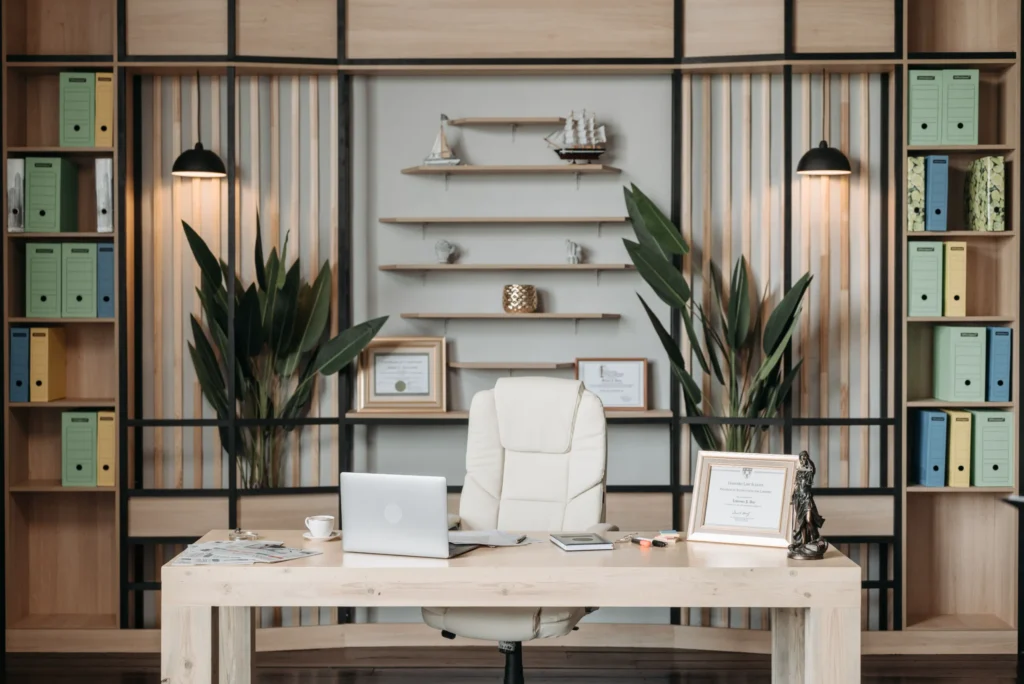
Sitting position with Camera Setting: When you are sitting at your desk, the center of the canvas should be right above your head; the painting should be visible in the middle and not hide behind your face. When hanging an artwork on the wall, do so at eye level, and make sure the artwork doesn’t look like it’s floating or dangling. 

The Framing Ratio: The width of the canvas should be at least 60-70% of the width of the background that your webcam captures when you’re in front of it. This will make sure that the edge of the frame is either beautifully cropped or well-defined and noted, meaning that you won’t be spending time fiddling with the edges of the frame to ensure you don’t have an excess of empty wall on either side.

Distance and Depth: If your desk is 3 to 5 feet away from the back wall, it will be really helpful, as the separation or distance will create a sense of depth. It will create an automatic depth-of-field effect. Your webcam will capture both you and your artwork or your surroundings, focusing on the art piece, and this sharp focus will make the background more beautiful and soft. 

Selecting The Appropriate Style For The Professional Identity You Are Looking To Project

The type of art you select will reflect your industry, the story you wish to tell, and your own preferences. The art style will dominate the overall tone of your virtual meeting, so it’s important that it’s large-scale and has a strong impact. Wall decor for Zoom meetings should not just be a unique piece of wall art for home office; it will be your identity. 

Abstract Expressions: The Universal Corporate Favorite

Abstract art is perhaps the most flexible option for video backgrounds. Since this type of art does not represent literal, specific objects, it doesn’t squander the viewers’ attention as a different object would. With high-contrast abstract expressionism, energy, modernity, and innovation come easily—ideal for tech entrepreneurs, marketers, and creative directors. Abstractions, in contrast, are fluid and soft and convey calmness, diplomacy, and strategic thinking, making them the best art or unique wall art for home offices, consultants, and corporate executives.

Minimalist Line Art and Color Fields: For Crisp Sophistication

minimalist art for home office
Minimalist Line Art

Minimalist art is a great friend if you want to show clarity, precision, and luxury. The large-format color field paintings (more akin to Mark Rothko) provide rich and immersive background images that are very high quality on HD cameras. Projects a very organized and precise mindset via monochromatic line art or geometric minimalism. It conveys to your clients that you value clean design and organized thinking.

Grounding Element of Modern Landscapes

For people in the legal, financial, or traditional corporate professions, abstract or overly stylized landscapes are the ideal mix between old and new. When using a large-scale horizon line or a forest to imply a sense of openness behind you, a small home office can seem spacious. Try not to have too many details in the landscape, as it can appear ‘muddled’ when the camera comes to capture it; prefer impressionistic or broad-brushed interpretations.

Understanding Color Theory for High-Definition Lenses

Color Theory

The human eye and webcams perceive colors differently. The color of your walls and the shade of your lights will change how you look on camera, so make a note of that balance between exposure and colors. Learn how cool, warm, or neutral tones work and can create different emotions and cohesive themes. 

The most common colors that work the best for the video backgrounds are blue, green, teal, and grey. 

From a cultural and psychological standpoint, cool colors give a sense of trust, stability, and calm—ideal for high-stakes negotiations or team syncs. Moreover, cool-toned backgrounds make a stunning contrast to human skin tones, which have warm tones, making you pop out from the background.

Working with Warm and Vibrant Colors:

The art that looks good in a large, open living room does not necessarily mean that it looks good on a video conference, too. Neon or crimson colors look beautiful in living rooms but can be a disaster in video meetings. The reds, oranges, and pinks will bounce the light back onto your face, which can make you look flushed, flabbergasted, sunburnt, or something; it can make you look weird. 

Try to choose warm colors that subdue, such as some earthy tones, which make the place look positive, like mustard gold or earthy tones like terracotta. 

Lighting and Texture: Technical challenges overcome

While looking for the best background ideas for virtual meetings, keep in mind the lighting of the room. A beautiful canvas can become an eyesore on a screen if it has glare or is poorly lit. Here are a few technical considerations to keep in mind when staging a large canvas for a digital backdrop:

The top rule of video backdrops is to say no to Glass. Don’t frame prints on traditional glass or acrylic. All that light you are using to illuminate the art will reflect directly off the glass and dazzle your camera’s lens, and be very distracting. Use a matte or satin-finish stretched canvas.

Favor Impasto and Texture: Any artwork done on canvas using palette knives, heavy texture, or even visible brushstrokes is truly spectacular on video. The physical texture will give your background depth and heaviness as it catches the light. It will create a tactile realism that will give your viewers a sense of viewing incredible art, not any digital wallpaper. 

Don’t use direct front-lighting: When the lighting directly shines on the canvas from the front, that can make the image look flat, and the color tone washed out. Instead, arrange your room lighting to cast a slanted light on the artwork, or use a soft, dimmable picture light above the painting to create a refined light wash like a gallery.

Explore more: TERAVARNA Explains Why You Should Buy Paintings for Office

Creating A Digital Boardroom Is A Fantastic Idea!

The mentalities we live in are formed by the spaces we live in, and the professional fates we project are formed by the spaces we project. When you install a large canvas art print in your work-from-home space, it’s a statement that you want to come across as professional or important, as you would in your own corporate office.

Selecting a jacket that blends scale, advanced color theory, and professional style will enhance all digital encounters. You move from a home chat to a focused and valuable meeting. Visit today’s markets, discover a canvas that embodies your dreams, and turn your digital background into a true work of art for professional branding.

Art for the “Work from Home” Era: Selecting Large-Scale Canvas for Video Call Backgrounds Read More »

Pricing Your Art: How to Attract Potential Buyers in 2026

pricing your artwork
Young girl thinking about pricing choices

Ready to sell your art, but can’t fix a price? Pricing your artwork can often make creators feel intimidated. Deciding the “right price” for your art, is not as overwhelming as it seems.

You might end up with a hefty amount or something minimal if you don’t have enough awareness about how to price your artwork. So, how do you deal with this challenge? This blog and artwork pricing guide has got you covered through five major ways to price your artwork for galleries, competitions, and online platforms.

Why Do You Need a Pricing Strategy for Selling Your Artworks?

Pricing Strategy

Whether you value your artwork for beginners, or experts, coming up with a strategy always works when it comes to choosing a fair amount that looks reasonable. A little trial and error with different price points will eventually assist you in making decisions that you won’t regret. When you run a business, you find strategies to streamline your operations. Likewise, an artist must follow a plan to price their artworks.

How to Price your artwork for Sale?

Know the Market Demands

Market Demand

If you have a look at the art marketplace, you can get a fair idea about the financial expectations of buyers. Once you have a foundational understanding of the market demands, fixing a price will be easy.

Whether it’s a studio, art fair, or a prestigious gallery, pricing your artwork is expected to vary in each case. Determining an arbitrary amount without researching the market demands will only lead to bad choices in pricing your artwork.

Compare Your Pricing with Competitors

Comparing prices with competitors in an art Gallery

When deciding the value of your artwork, exploring competitors’ costs is a good choice to make. Conduct your own research on what fellow artists are charging for their creations.

If you both have similarities in medium, style, materials, or expertise, deciding a price will be comparatively easy. On the other hand, if there are visible differences between you and the competitors, you can refer to other strategies in an artwork pricing guide.

For example, reaching out to fellow creators can kickstart a conversation, providing you with ample insights into their price strategies. Other than networking, check out online platforms or visit an exhibition to find out the value of paintings, particularly those that are in line with your artistic style or medium.

Maintain a Fine Balance in Pricing

Financial balance

The value of your artworks must be in good balance so that neither you are underpaid nor the buyer is overwhelmed with the price tag. While pricing artwork for beginners should traditionally be nominal, if you have made a lot of progress in a short space of time, go with a reasonable amount—but still not too high.

Start slow and build your career gradually, and as you gain more experience and skills, you’ll be confident enough to fix a higher price.

Formula for Pricing your Artwork

A woman painting in her studio

You need a little bit of mathematics to estimate the price of your artworks. For that, first decide on the amount you’ll be charging per square inch before moving on to calculate the total value.

For example, if you plan to charge $7 per square inch for your art, follow the steps below:

  • Multiply the value ($7) by the length and width of your canvas.
  • Figure out the cost of your art supplies and double them to cover the expenses.
  • Add the total amount, and you are all set!

Maintain a Consistent Pricing

A buyer deciding between artworks   meant for sale

Maintaining consistency is as important as being transparent in deciding a value. Why? It’s because a big difference in prices across galleries can dissuade buyers from making a purchase.

Besides, it is a fair choice to be consistent for building trust among your customers, avoiding confusion, and maintaining a positive relationship with galleries.

Bottom Line

It might be easy to get carried away by emotions when pricing your artwork. However, taking note of parameters like market demands or competitor costs will help you come up with a value that is not only just right for you but also looks fair to the buyer.

Do not compromise your worth, nor propose a hefty amount—especially when pricing artwork for beginners. Planning right strategy and art promotion techniques give you enough clarity into the pricing process. So, if you are ready to fix an amount, follow this artwork pricing guide and say goodbye to regretful decisions forever!

Pricing Your Art: How to Attract Potential Buyers in 2026 Read More »

×


Scroll to Top

You can get much more discounts on these subscription plans